
Chapter 3
In Chapter 2, we looked at forwards and futures: agreements to buy or sell a specific asset at a specific price in the future. Those contracts are fantastic for managing the price risk of physical goods like corn, gold, or oil.
But what if your biggest financial risk isn’t a commodity? What if your biggest risk is the cost of money itself?
For massive corporations, governments, and investment banks, the most terrifying variable on the balance sheet is often the interest rate. If a company borrows a billion dollars to build a new factory, a sudden spike in central bank interest rates could increase their monthly loan payments by millions, wiping out their profit margins overnight.
To manage this, the financial world created the Interest Rate Swap. It is one of the most heavily traded financial instruments on the planet, with hundreds of trillions of dollars in active contracts. In this chapter, we are going to demystify the swap, learn why corporations desperately need them, explore recent massive shifts in global interest rate benchmarks, and apply our No-Arbitrage rule to figure out exactly how much a swap is worth.
Let’s swap.
3.1 The Motivation: Fixing the Balance Sheet
An interest rate swap is an Over-The-Counter (OTC) agreement between two parties to exchange one stream of future cash flows for another.
To understand why anyone would do this, let’s look at a classic corporate finance problem.
Meet TechCorp. TechCorp wants to borrow $100 million to build a new data center. They go to their commercial bank for a loan. The bank agrees to lend them the money, but because the economic future is uncertain, the bank refuses to give them a fixed interest rate. Instead, the bank offers a Floating-Rate Loan.
The bank says: “We will charge you the current market benchmark interest rate, plus a 2% penalty for credit risk.” If the market benchmark rate is currently 3%, TechCorp pays 5% total. But if inflation spikes and the central bank raises the benchmark rate to 8%, TechCorp’s loan suddenly costs 10%.
TechCorp’s Chief Financial Officer is terrified. They need predictable, fixed costs to plan their budget. They don’t want to gamble on the direction of global interest rates.
The Solution: TechCorp calls up an investment bank (let’s call them SwapBank) and enters into a Plain Vanilla Interest Rate Swap.
3.2 Fixed vs. Floating: The Plain Vanilla Swap
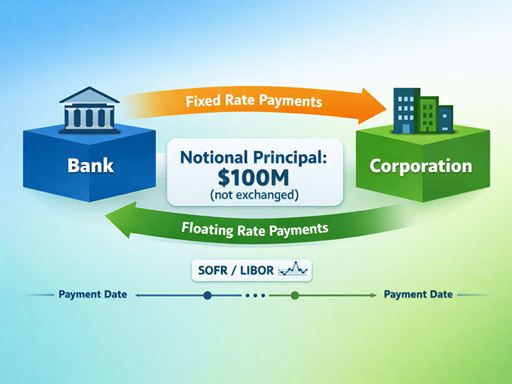
The “Plain Vanilla” swap is the simplest and most common swap structure. In this agreement, one party pays a Fixed Rate and receives a Floating Rate, while the other party does the exact opposite.
Let’s see how this completely solves TechCorp’s problem.
The Setup:
- Notional Principal: $100 Million. (Crucial Note: The parties never actually exchange this $100 million. It is purely a dummy number, a “notional” amount, used solely to calculate the interest payments).
- TechCorp’s Loan: They owe their commercial bank (Floating Benchmark + 2%).
- The Swap Agreement: TechCorp agrees to pay SwapBank a purely fixed rate of 4%. In exchange, SwapBank agrees to pay TechCorp the Floating Benchmark rate.
Let’s calculate TechCorp’s net position:
- TechCorp pays the Commercial Bank: -(Floating + 2%)
- TechCorp pays SwapBank (The Swap): -4% (Fixed)
- SwapBank pays TechCorp (The Swap): +Floating
Notice what happens mathematically. The “+ Floating” they receive from SwapBank perfectly cancels out the “- Floating” they owe on their loan!
Net Result: TechCorp is left paying exactly 6% Fixed (the 4% fixed to SwapBank + the 2% credit spread to the commercial bank).
Through the magic of derivatives, TechCorp has synthetically transformed a dangerous floating-rate liability into a safe, predictable fixed-rate liability. They didn’t have to cancel their original loan; they just layered a swap on top of it. This is balance sheet wizardry at its finest.
3.3 Global Benchmark Evolution
In our TechCorp example, we kept referring to a “Floating Benchmark.” But what exactly is that benchmark?
For nearly 40 years, the undisputed king of global interest rates was LIBOR (The London Interbank Offered Rate). It was supposed to represent the average interest rate at which massive global banks lent money to each other on an unsecured basis. Trillions of dollars in mortgages, student loans, and corporate swaps were tied to LIBOR.
Why LIBOR Failed
Following the 2008 financial crisis, a massive, systemic scandal broke. Regulators discovered that LIBOR wasn’t based on actual, verifiable transactions. Instead, a panel of bankers simply submitted estimates of what they thought they would be charged to borrow money.
Because these were just estimates, traders at various banks colluded to intentionally lie and manipulate the LIBOR rate up or down to make their own derivative portfolios more profitable. The bedrock of global finance turned out to be manipulated.
The New Sheriff: SOFR
Regulators globally mandated the death of LIBOR, leading to one of the most complex financial transitions in history. In the United States, LIBOR was replaced by SOFR (The Secured Overnight Financing Rate).
Unlike LIBOR, SOFR is bulletproof.
- It is based on actual transactions: SOFR is calculated using roughly a trillion dollars of actual trades happening every single day in the U.S. Treasury repurchase (repo) market.
- It is secured: The loans are collateralized by U.S. Treasury bonds, meaning it is a nearly risk-free rate, untainted by the credit risk of individual banks.
As an undergraduate entering modern finance, you must understand that the plumbing has changed. When you look at an interest rate swap today, the floating leg is almost entirely tied to robust Alternative Reference Rates (ARRs) like SOFR.
3.4 Swap Valuation Principles: Bundling Forwards
How do we figure out the mathematically “fair” fixed rate (like the 4% we used in the TechCorp example) when the swap is first created? Furthermore, how do we value the swap halfway through its life?
Once again, we rely on the No-Arbitrage Principle.
To a financial engineer, an interest rate swap is not one single complicated contract. It is simply a bundle of individual, linear forward contracts tied together. Think of it like a sleeve of tennis balls.
Each payment date in the swap (e.g., every 6 months for the next 5 years) is essentially a Forward Rate Agreement (FRA).
- To price the swap, we look at the yield curve today and mathematically project what the market predicts the SOFR rate will be at each future payment date.
- We calculate the expected net cash flow for each date (Fixed Rate minus Expected Floating Rate).
- Finally, we discount all those future cash flows back to today to find their Net Present Value (NPV).
The Golden Rule of Swap Initiation:
On Day 1, the moment a swap is signed, its Net Present Value must be exactly Zero.
Neither party is handing the other a briefcase full of cash to enter the trade. The Fixed Rate is mathematically calculated and chosen specifically so that the present value of all expected fixed payments perfectly equals the present value of all expected floating payments.
However, as time passes, the real-world SOFR rate will fluctuate. It will deviate from our original projections.
- If interest rates skyrocket, the party receiving floating and paying fixed is thrilled! Their side of the swap gains massive value (Positive NPV).
- The party paying floating and receiving fixed is losing money (Negative NPV).
Because swaps are OTC contracts, the parties will monitor this NPV daily. If one party wants to tear up and cancel the contract three years early, they will have to write a check to the other party exactly equal to the current Net Present Value of the remaining cash flows.
<br>
Chapter Summary
- The Motivation: Corporations utilize interest rate swaps to actively manage their balance sheet liabilities, typically synthetically transforming risky floating-rate debt into predictable fixed-rate debt (or vice versa).
- The Mechanics: “Plain Vanilla” swaps involve exchanging fixed and floating interest payments based on a Notional Principal, which is never actually exchanged.
- The Benchmark Evolution: The global financial system has transitioned away from the discredited, estimate-based LIBOR to robust, transaction-based Alternative Reference Rates (ARRs) like SOFR, which is secured by U.S. Treasuries.
- Valuation (NPV): A swap is structurally a portfolio of individual Forward Rate Agreements (FRAs). The fixed rate is set at initiation so that the Net Present Value (NPV) of the swap is exactly zero. As rates change over time, the NPV shifts to favor one counterpart over the other.
<br>
Discussion Questions
- If you are the CEO of a company that issues a massive amount of Fixed-Rate bonds right before the economy enters a severe recession (and central banks aggressively cut interest rates to 0%), how could you use a swap to benefit from the falling rates?
- Why is it crucial that the “Notional Principal” is never exchanged in an interest rate swap? How does this impact the credit risk of the trade compared to giving a traditional loan?
- LIBOR was an “unsecured” rate (reflecting bank credit risk), while SOFR is a “secured” rate (backed by U.S. Treasuries). During a severe banking panic, how would you expect these two different types of rates to behave relative to each other?
Step-by-Step Exercise: Calculating the Net Cash Flow
Let’s step into the shoes of SwapBank’s back-office settlement team. It is payment day, and you need to calculate who owes who.
The Setup:
- Notional Principal: $50,000,000.
- Payment Frequency: Semi-annual (payments happen every 6 months, so we divide the annual rates by 2).
- The Agreement: SwapBank pays SOFR and receives 5.00% Fixed from Client A.
- The Reality: Six months ago, the SOFR rate was formally “set” at 4.20% for this current payment period.
Calculate the following:
- Step 1: Calculate the dollar amount Client A owes SwapBank for the Fixed Leg. (Hint: Notional × Fixed Rate × 0.5)
- Step 2: Calculate the dollar amount SwapBank owes Client A for the Floating Leg. (Hint: Notional × SOFR Rate × 0.5)
- Step 3: These payments are “netted” against each other. Who writes the final check today, and for exactly how much?
(Mastering this simple cash flow netting is the first step to building complex valuation models later in the curriculum!)
