
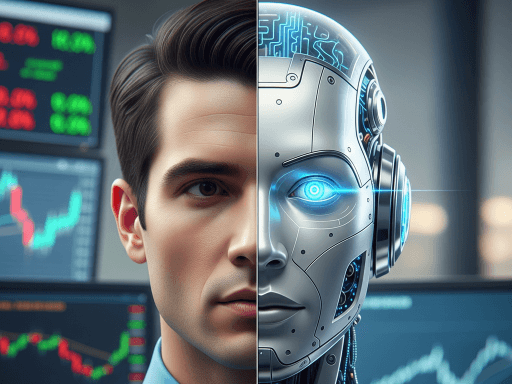
For decades, the quantitative analyst, or “quant,” has been the wizard behind the curtain of modern finance. The quant is a unique hybrid of mathematician, computer scientist, and market strategist. Their job is to tame the chaotic beast of the market with logic, data, and code. Their world was one of elegant equations and brute-force backtesting. But a new force is rewriting the rules of this high-stakes game.
That force is Artificial Intelligence.
We aren’t talking about the simple algorithmic trading that has been around for years. This is a fundamental paradigm shift, a revolution powered by AI that can learn, reason, and even create. The latest advancements in Generative AI, LLMs, and Reinforcement Learning are not just adding another tool; they are rebuilding the entire toolbox.
Let’s explore the impact of this new wave of AI on the day-to-day work of a quant. We’ll examine how it’s changing their workflow right now and what the foreseeable future holds for one of finance’s most demanding professions.
The Traditional Quant’s Workflow: A Quick Refresher
To understand the revolution, we must first understand the old world. A quant’s primary objective is to find “alpha”. Their daily work traditionally followed a rigorous, step-by-step process:
- Hypothesis Generation: It all starts with an idea, a theory about a market inefficiency. For example, “I believe that when a company’s CEO appears on the news, its stock volatility increases for the next 48 hours.”
- Data Sourcing & Cleaning: The quant then gathers historical data to test this idea. This involves finding reliable sources for stock prices, news mentions, and other financial data. This stage is notoriously painful. Up to 80% of a quant’s time is spent sourcing, cleaning, and aligning messy, incomplete datasets.
- Model Building & Backtesting: Using their hypothesis and clean data, the quant builds a mathematical model. They then write code to backtest this model against years of historical data to see if it would have been profitable.
- Risk Management & Execution: If the model proves successful, it’s deployed into the real world. This involves building risk management overlays and creating algorithms to execute trades based on the model’s signals.
This process is methodical, intellectually demanding, and heavily reliant on the quant’s own expertise and intuition.
The Current Impact: A Day in the Life of an AI-Augmented Quant
Imagine a quant starting their day in 2025. Their role is no longer just about building models; it’s about orchestrating a suite of intelligent AI agents. Let’s walk through their workflow now.
Stage 1: The Data Deluge Becomes an Ocean of Opportunity
The biggest bottleneck for the traditional quant was data. AI has turned this limitation into a massive advantage.
- Before: Quants were largely restricted to structured numerical data like stock prices, trading volumes, and economic figures from different sources.
- Today’s AI Impact: The scope of “data” has exploded. AI makes it possible to systematically extract signals from vast, unstructured, and alternative datasets.
- LLMs as Research Analysts: A quant now uses a Large Language Model (LLM). This replaces the need to manually read thousands of pages of SEC filings or earnings call transcripts. They can ask it plain-English questions like, “Summarize the key risk factors mentioned in the latest 10-K filings for all companies in the S&P 500 tech sector” or “Analyze the sentiment of the Q&A section of Tesla’s latest earnings call.” The AI delivers a structured summary in seconds.
- Tapping Alternative Data: Hedge funds are using AI to analyze satellite imagery. They count cars in Walmart parking lots to predict retail sales. They’re tracking the flight paths of corporate jets. They analyze geolocation data from mobile phones. They process credit card transaction data. This provides a real-time pulse on the economy, long before official government statistics are released.
- Automated Cleaning: AI tools can now intelligently identify and correct errors. They can fill in missing values and normalize data from various sources. This frees the quant from the drudgery of data janitorial work.
Stage 2: Alpha Discovery – Finding the Signal in the Noise
This is where AI truly shines. The search for alpha is no longer limited by human hypotheses.
- Before: Alpha signals were born from a quant’s personal experience and domain knowledge. This process was inherently biased and limited in scope.
- Today’s AI Impact: AI models are finding profitable patterns that are invisible to the human eye.
- Generative AI for Idea Generation: LLMs can read every financial news story, every tweet from an influential trader, and every research report published, and then generate novel trading hypotheses based on hidden correlations.
- Automated Feature Engineering: This is a game-changer. “Features” are the input variables used in a model (e.g., price-to-earnings ratio). Historically, creating good features was an art form. Now, AI systems can automatically generate hundreds or even thousands of potentially predictive features from raw data.
- Deep Learning for Non-Linearity: Financial markets are not simple and linear. Deep learning models can identify incredibly complex, non-linear relationships that traditional statistical models would miss entirely. A case study from Bridgewater Associates showed that their new AI models achieved higher Sharpe ratios than their traditional models.
Stage 3: Coding & Model Development – The Quant’s New Co-Pilot
Writing robust, efficient, and bug-free code is paramount. AI is dramatically accelerating this process.
- Before: Hours, days, and weeks spent over a screen, writing code , debugging it, and optimizing it for speed.
- Today’s AI Impact: LLM-powered coding assistants act as a partner in the coding process.
- Code Generation: A quant can write a comment describing a function
"Create a function to download historical price data for a list of tickers from Yahoo Finance and calculate their 50-day moving average” and the AI will generate the complete Python code in an instant. - Debugging and Optimization: If a complex model is running slowly, the quant can ask the AI, “How can I optimize this code for better performance?” and receive concrete suggestions.
- Translation: Need to convert a legacy model from R to Python? AI can do the bulk of the translation work automatically. The consensus is that these tools are providing a 20-40% productivity boost to development teams.
- Code Generation: A quant can write a comment describing a function
The Foreseeable Future: The Quant as AI Shepherd
So, if AI can source data, generate ideas, and write code, is the quant profession doomed? Far from it. The role is not disappearing; it is evolving. The quant of the future is less of a hands-on builder and more of an AI shepherd or AI conductor.
Their focus will shift from manual labour to high-level strategic oversight:
- From Coder to System Designer: Instead of writing every line of code, the future quant will design the architecture of AI systems. Their job will be to ask the right questions and set the right goals for their AI agents.
- From Modeler to Master Validator: The most critical skill will be validation. AI models can easily find misleading patterns in data (spurious correlations). They will need to design robust tests to ensure an AI-generated strategy is genuinely predictive and not just a product of data mining bias. They are the essential “human-in-the-loop” who can pull the plug when an AI goes rogue.
- The AI-Fluent Quant: The required skillset is expanding. A deep understanding of finance and mathematics is still the price of entry, but it’s no longer enough. The new quant must master machine learning frameworks like TensorFlow and PyTorch. They also need expertise in Natural Language Processing (NLP) and cloud computing architecture.
The Elephant in the Room: Challenges and Guardrails
This brave new world is not without its perils. The widespread adoption of AI in finance presents significant challenges that the industry is actively grappling with.
- The “Black Box” Problem: Many advanced AI models are opaque. We can see the input and the output, but we can’t fully understand the decision-making process within. This is a massive problem for risk management. How can a firm sign off on a trading strategy if no human understands precisely why it’s making certain trades? This has given rise to a new field: Explainable AI (XAI).
- Overfitting and Spurious Correlations: An AI with enough data can find a “correlation” between sunspot activity and the price of tea. The quant’s role is to apply rigorous statistical methods and market intuition to distinguish real signals from this noise.
- Regulatory Hurdles: Regulators are racing to catch up. How do you ensure an AI model is fair, non-discriminatory, and stable? Firms using AI face a complex and evolving compliance landscape.
- Systemic Risk: What happens when every major hedge fund is using similar AI models trained on similar data? It creates the potential for herd behavior on a massive scale, leading to unforeseen feedback loops and the risk of AI-driven flash crashes.
Conclusion: The Enduring Value of the Human Mind
AI is undeniably reshaping the landscape of quantitative finance. It is automating the tedious, accelerating the complex, and unlocking sources of alpha that were previously inaccessible. The quant’s day-to-day work is becoming less about manual data wrangling and coding and more about strategic oversight, creative problem-solving, and rigorous validation.
The tools are changing, but the core mission remains the same. The essence of being a great quant has never been about simply crunching numbers. It has always been about curiosity, a healthy dose of skepticism, and an intuitive understanding of how markets and the humans behave.
In the age of AI, these human qualities are not just relevant; they are more valuable than ever. The future of the financial markets belongs to those who can masterfully blend the art of human insight with the powerful science of artificial intelligence.
